
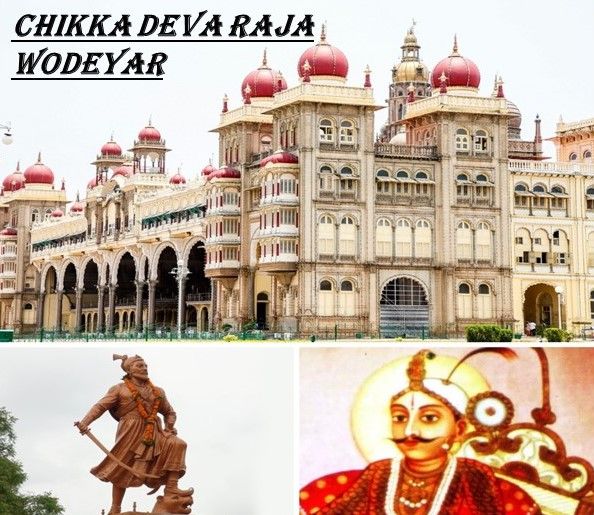
The reign of Chikka Devaraja Wodeyar II (1673–1704) occupies a pivotal chapter in the history of Mysore. His legacy is marked by both impressive achievements and inherent vulnerabilities. While he expanded Mysore’s territorial reach and laid down administrative foundations that endured for generations, his reliance on external alliances and Mughal recognition left the state simultaneously empowered and constrained.
Territorial Expansion and Alliances
Under Chikka Devaraja’s leadership, Mysore steadily grew from the mid-seventeenth to the early eighteenth century. His southeastern acquisitions, such as Salem, were not directly contested by the Mughal emperors but were secured through cooperation with regional powers. He worked closely with Khasim Khan, the Mughal Faujdar-Diwan of Sira, and Venkoji, the Maratha ruler of Tanjore. These alliances allowed Mysore to extend its influence into new territories.
Yet, these partnerships were fragile. The siege of Trichinopoly, for instance, had to be abandoned when one such alliance collapsed. This episode highlights the precarious nature of Mysore’s expansion—territorial gains were often contingent on shifting loyalties rather than enduring strength.
Diplomacy with the Mughals
Chikka Devaraja Embassy to Aurangzeb in 1700 exemplifies the dual nature of his legacy. On one hand, it brought prestige: Mysore received a royal seal, a ceremonial sword, and formal recognition by the Mughal emperor. This elevated Mysore’s standing in the Deccan and showcased its growing importance.
On the other hand, this recognition came at a cost. Mysore was obliged to pay an annual tribute, placing the kingdom in a position of formal subordination to Mughal authority. Thus, while the embassy enhanced Mysore’s prestige, it also underscored its dependence on imperial power.
Administrative Reforms
One of Chikka Devaraja’s most enduring contributions was his administrative restructuring. He established the celebrated athaara kacheri eighteen departments that streamlined governance and improved efficiency. This system became a hallmark of Mysore’s administration and influenced later rulers.
However, even these reforms may have been inspired by Mughal models. The adoption of imperial practices reflects both innovation and imitation, suggesting that Mysore’s internal strength was partly shaped by external influences.
A Legacy of Strength and Fragility
Chikka Devaraja Wodeyar II left behind a kingdom that was larger, more organized, and more prestigious than before. His territorial expansions and administrative reforms provided a strong foundation for Mysore’s future rulers. Yet, the reliance on unstable alliances and Mughal recognition meant that this strength was not entirely self-sustaining.
His successor inherited a state that was both empowered and constrained—territorially ambitious but diplomatically vulnerable, administratively advanced but politically dependent. This paradox defined Mysore’s trajectory in the early eighteenth century and set the stage for future challenges and transformations.
Conclusion
The legacy of Chikka Devaraja Wodeyar II is best understood as a blend of achievement and limitation. He expanded Mysore’s horizons and strengthened its governance, but his reliance on external powers left The Kingdom Exposed to Shifting Political Currents. His reign illustrates the complexities of state-building in South India during a period of intense regional and imperial competition.
By balancing ambition with dependence, Chikka Devaraja shaped Mysore’s destiny in ways that were both empowering and precarious a legacy that continues to intrigue historians of South Indian heritage.