
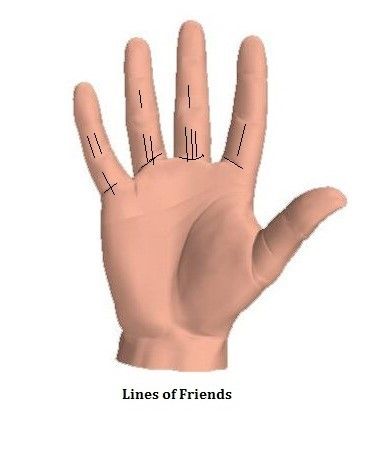
Palmistry, the age-old practice of interpreting the lines and shapes of the hand, has long fascinated those seeking to understand personality, destiny, and relationships. Among the many markings studied by palmists, The Lines of Friends are considered particularly significant. These auxiliary lines, found on the phalanges of the fingers, are believed to reveal the presence, quality, and sincerity of friendships and associations in an individual’s life.
What Are Lines of Friends?
- The Lines of Friends are vertical lines located on the phalanges (the segments of the fingers).
- Their presence indicates companionship, social connections, and moral support from friends and associates.
- If these lines are absent, palmists often interpret the person as a loner, someone who may struggle to form close bonds or receive support from others.
- Strong, clear lines suggest loyal and earnest friends, while weak or faint lines may point to betrayal, lack of cooperation, or superficial relationships.
Indications of Lines of Friends
Palmistry also considers the orientation of these lines—vertical or horizontal—as important indicators:
- Horizontal lines on phalanges:
- Prominent horizontal lines signify strong foes.
- Weak horizontal lines suggest adversaries who can be easily overcome.
- Index finger (Jupiter finger):
- Vertical lines denote friends in service or professional life.
- Horizontal lines indicate foes in service.
- Middle finger (Saturn finger):
- Vertical lines suggest creative and inventive friends.
- Horizontal lines point to disloyal companions.
- Ring finger (Apollo finger):
- Vertical lines denote friendships with esteemed or renowned individuals.
- Horizontal lines signify enemies in high official positions.
- Little finger (Mercury finger):
- Vertical lines represent friends from the business community.
- Horizontal lines suggest betrayal or deception from business associates.
Symbolism and Interpretation
The clarity and strength of these lines are said to mirror the sincerity and reliability of friendships:
- Prominent vertical lines → trustworthy, supportive friends.
- Weak vertical lines → unreliable companions, potential betrayal.
- Strong horizontal lines → powerful adversaries.
- Faint horizontal lines → insignificant or easily manageable foes.
Palmists emphasize that these interpretations are symbolic rather than deterministic. They reflect tendencies and possibilities rather than fixed outcomes, encouraging individuals to reflect on the nature of their relationships.
The Need for Further Study
Although palmistry provides intriguing insights, the Lines of Friends remain an area requiring deeper exploration. Experienced palmists continue to research their meanings, as these markings are closely tied to the complexities of human relationships. Since friendships and enmities shape much of personal and social life, understanding these lines could enrich the broader study of hand reading.
Conclusion
The Lines of Friends in palmistry highlight The Importance of Companionship, trust, and social bonds in an individual’s journey. Whether vertical or horizontal, strong or weak, these lines are interpreted as reflections of the support or challenges one may encounter through friends and associates. Though palmistry is not a science in the modern sense, it offers a symbolic framework that encourages reflection on the role of relationships in shaping destiny.