
Introduction
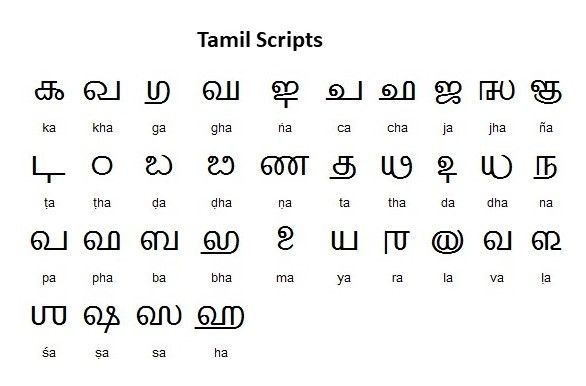
The Tamil script is one of the most distinctive writing systems in the world, primarily associated with the Tamil language an ancient tongue with a continuous literary tradition spanning over two millennia. Beyond Tamil, the script has also been adapted to write languages such as Paniya, Irulas, Badaga, and Saurashtra. To accommodate Sanskrit, Tamils introduced diacritics to represent aspirated and voiced consonants absent in the original system. Unlike other Indic scripts derived from Brahmi, Tamil Stands out for its Simplicity: it uses the same character for both voiced and unvoiced stops (for example, krepresents both k and g) and rarely employs conjunct consonantal ligatures, reflecting the phonetic nature of Tamil.
Historical Development
The Tamil script traces its roots to Brahmi, evolving after the Asokan Era. Early inscriptions were written in Grantha, Brahmi, and Vatteluttu. By the 7th century CE, inscriptions began to resemble modern Tamil characters. Scholars debate whether Tamil directly evolved from Brahmi or had a distinct identity from the earliest times, as suggested by references in Tolkappiyam, a grammar text dating back to the 3rd century BCE.
Tamil Brahmi inscriptions from the 2nd century CE already displayed features aligned with Tolkappiyam. By the 5th and 6th centuries, the script transitioned into early Vatteluttu. The Pallava dynasty simplified Grantha in the 7th century to create a new Tamil script, incorporating Vatteluttu letters for sounds absent in Sanskrit. This script gradually replaced Vatteluttu in Chola and Pallava regions, while Vatteluttu persisted in Chera and Pandyan territories until the 11th century. Over time, the Chola-Pallava script evolved into modern Tamil, influenced by palm-leaf manuscripts that shaped the rounded forms of letters.
Later reforms included the reintroduction of the pulli (dot) to mark pure consonants, while some vowel markers like kurriyal ukaram fell out of use. In the 19th and 20th centuries, further simplifications and standardizations made the script more suitable for printing and modern communication.
Classification of Words
Tamil words are traditionally classified into four categories:
- Uriccol: Root words, common in ancient poetry but rare today.
- Nouns (Peyarcol): Represent animate and inanimate categories, divided into Uyartinai (higher beings such as gods, humans, demons) and Akrinai (inferior beings, including inanimate objects).
- Verbs (Vinaiycol): Express actions.
- Particles (Itaiccol): Function words that connect or modify meaning.
Gender distinctions exist within Uyartinai(masculine, feminine, neuter), while Akrinaicovers singular and plural impersonal classes.
Structure of Tamil Letters
Modern Tamil letters derive from Vatteluttu and consist of:
- 12 vowels (Uyir): Five short, five long, and two diphthongs.
- 18 consonants (Mei): Divided into three groups:
- Vallinam (hard consonants),
- Mellinam (soft consonants, including nasals),
- Idayinam (medium consonants).
Together, vowels and consonants form compound letters (uyirmei), symbolizing the union of body and soul.
Modern Adaptations
Contemporary Tamil incorporates additional characters from Grantha to represent sounds absent in classical Tamil, such as ja, sha, and ha. These are now part of the standard Tamil alphabet taught in schools and encoded in Tamil Nadu’s TACE 16 system. To accommodate foreign sounds, combinations of Tamil letters are used to represent f, z, and x, especially for English and Arabic loanwords.
Tamil in Unicode
Tamil is Encoded in Unicode within the range U+0B80–U+0BFF. Unicode follows logical order (consonant first), while older encodings like TSCII followed written order, requiring rearrangement during conversion. Both Unicode and ISCII treat Tamil as an abugida, reflecting its syllabic structure.
Conclusion
The Tamil script is a remarkable example of linguistic resilience and adaptation. Rooted in ancient traditions yet evolving through centuries, it continues to serve as a vital medium for literature, culture, and modern communication. Its unique features distinguish it from other Indic scripts, underscoring the rich heritage of the Tamil language and its enduring legacy.