
Introduction
Santhali dance is one of the most vibrant and expressive folk traditions of India, performed by the Santhal tribe, the largest tribal community in Jharkhand and West Bengal, with notable populations in Odisha, Bihar, Assam, and Tripura. The Santhals belong to the Austroasiatic-speaking Munda ethnic group, and their native language, Santali, is a vital marker of their cultural identity. This dance form has gained recognition across India and has even been featured in Bengali cinema, such as Satyajit Ray’s Agantuk. More than just entertainment, Santhali dance reflects the tribe’s unity, devotion, and deep connection with nature.
Performance of Santhali Dance
Santhali dance is performed in groups, often resembling the bamboo dances of Assam and Mizoram. The Santhals are devotees of Thakurji, whom they regard as the creator of the world. Their rhythmic movements, accompanied by music, celebrate the beauty of nature and convey stories, emotions, and social messages while offering prayers to their deity.
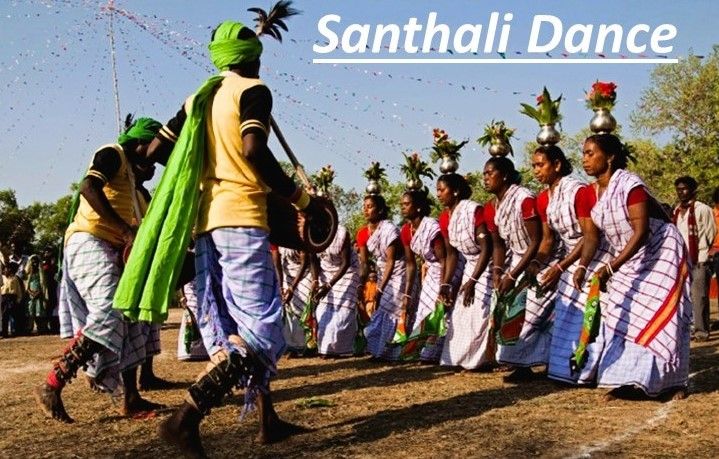
Both men and women participate in the dance, forming circles or semi-circles. Male and female dancers often perform in separate rows, interlocking their arms and creating cluster formations. The dance is accompanied by traditional instruments such as flutes, drums, pipes, and cymbals, which add to the festive atmosphere. Singers complement the rhythm, making the performance lively and engaging.
Santhali dance is primarily performed during spring festivals, often in forested areas, as a dedication to forest gods and goddesses. It is also performed to welcome guests, showcasing the tribe’s hospitality and communal spirit.
Costumes of Santhali Dance
Costumes play a central role in enhancing the visual appeal of Santhali dance:
- Men: Male dancers wear dhotis and turbans, adorning their bodies with branches, leaves, and flowers. This reflects their closeness to nature and their belief in natural adornments.
- Women: Female dancers wear white or yellow sarees with red borders, with the saree length ending just above the heel. They decorate their hair with wildflowers, adding charm and vibrancy to the performance.
The colorful costumes, combined with natural decorations, are one of the main attractions of Santhali dance, drawing audiences from across India.
Santhali Dance and Tourism
Santhali dance has become a major cultural attraction in Jharkhand and West Bengal. Thousands of tourists visit these regions to witness the performances, especially during the spring festival, when the celebrations are at their peak. The dance not only entertains but also provides insights into the traditions, values, and lifestyle of the Santhal tribe.
Researchers and cultural enthusiasts continue to study Santhali dance to understand its origins, symbolism, and significance. Its popularity has grown beyond tribal boundaries, making it A Celebrated Folk Tradition across India.
Conclusion
Santhali dance is more than a folk performance it is a symbol of unity, devotion, and cultural identity. Rooted in nature and tradition, it reflects the Santhal tribe’s way of life, their reverence for the divine, and their communal harmony. With its vibrant costumes, rhythmic movements, and soulful music, Santhali dance continues to captivate audiences and preserve the rich heritage of India’s tribal culture.