
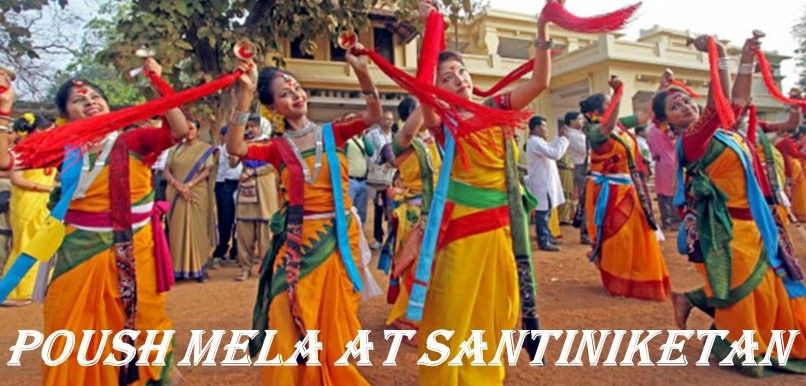
Poush Mela, held annually in Santiniketan in the Birbhum district of West Bengal, is one of India’s most vibrant cultural festivals. Rooted in spirituality and enriched by art, music, and tradition, this fair marks the harvest season and begins on the 7th day of the Bengali month of Poush. Though officially lasting three days, vendors often remain until the end of the month, keeping the festive spirit alive for weeks.
Historical Background
The origins of Poush Utsav trace back to 21 December 1843 (7 Poush 1250 in the Bengali calendar), when Devendranath Tagore, along with twenty followers, embraced the Brahma creed under the guidance of Ram Chandra Vidyabagish. This spiritual milestone laid the foundation for the annual festival at Santiniketan.
Later, on 21 December 1891 (7 Poush 1298), the Brahma Mandir was established. To commemorate its anniversary, a small fair was organized opposite the temple grounds. What began as a modest gathering gradually evolved into a grand celebration, attracting visitors from across India and abroad. Initially held near the Glass Temple, the fair was later shifted to the larger grounds of Purbapalli to accommodate the growing crowds.
Inauguration Rituals
The festival typically begins around 23rd December. At dawn, the melodious notes of the shehnai awaken Santiniketan to a Festive Mood. The Vaitalik group leads the proceedings by singing devotional songs while moving around the ashrama. A prayer meeting at Chhatimtala follows, after which the congregation moves to Uttarayan, singing in unison.
A highlight of the mela is the live performance of Baul songs, a unique genre of Bengali folk music. Alongside music, the fair features dance, folk plays, and sports, offering a rich glimpse into Bengal’s cultural heritage. Students of Santiniketan also participate, adding youthful energy and charm to the festival. The final day is dedicated to the local community, reinforcing the bond between Santiniketan and its people.
The Fair Experience
Beyond cultural performances, Poush Mela is a bustling marketplace. Around 1,500 vendors set up stalls, showcasing local handicrafts, printed fabrics, and traditional items. Tourists eagerly explore these stalls, taking home souvenirs that reflect Bengal’s artistry.
Visitor numbers are staggering. While Santiniketan usually sees about 3,500 tourists daily, during festivals like Poush Utsav, Basanta Utsav, Rabindra Paksha, and Naba Barsha, the inflow surges to nearly 40,000 per day. This immense turnout highlights the popularity of the mela and its significance in Bengal’s cultural calendar.
Cultural Significance
Poush Mela is more than a fair it is a celebration of Bengal Spiritual and Artistic Traditions. It bridges the past and present, honoring the legacy of Devendranath Tagore while showcasing the creativity of modern artisans and performers. The festival embodies the essence of Santiniketan, envisioned by Rabindranath Tagore as a hub of learning and culture.
Ultimately, Poush Mela is a living tradition that continues to inspire generations. It is a reminder of Bengal’s rich heritage, where spirituality, art, and community come together in harmony.