
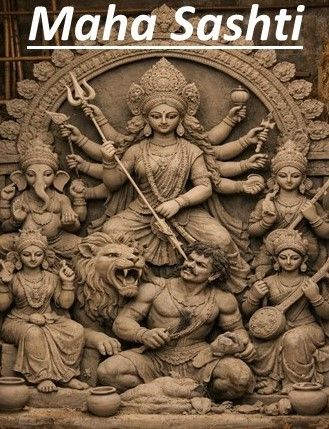
Maha Sashti, the sixth day of Devi Paksha, is a festival day that resonates with deep cultural and spiritual meaning across Bengal and eastern India. It marks the formal commencement of Durga Puja, a celebration that blends devotion, mythology, and vibrant traditions into one of the most anticipated events of the year.
Rituals of Maha Sashti
On Maha Sashti, four central rituals welcome Goddess Durga into Community Pandals and households:
- Kalparamvo — The symbolic initiation of the puja.
- Bodhan — Consecration of the idol and unveiling of the Goddess’s face.
- Amantran — Inviting the Goddess to dwell among devotees.
- Adhivas — Sanctifying the Goddess’s stay in the puja area.
These rituals, performed in both community pandals and traditional zamindari households, set the stage for days of worship, music, and joyous celebration.
Mythology of Maha Sashti
According to the Ramayana, Lord Rama performed Durga Puja during autumn before his battle against Ravana. Since this period falls under Dakshinayana, when gods are believed to rest, Rama had to awaken Goddess Durga prematurely. This act is known as Akal Bodhan (untimely invocation), a concept deeply tied to Maha Sashti.
Mythology in Bengal
In Bengal, Maha Sashti carries a more familial symbolism. Goddess Durga, identified with Uma or Parvati, is believed to visit her father’s home from Mount Kailash, accompanied by her four children — Ganesha, Kartikeya, Lakshmi, and Saraswati. The Bengali community welcomes her as a daughter returning home, symbolizing warmth, love, and divine blessings.
Kalparambha and Akal Bodhon
Traditionally, Goddess Durga was worshipped in the Chaitra month. However, Lord Rama’s invocation shifted the practice to autumn. The ritual of Kalparambha on Maha Sashti is considered equivalent to Ghatasthapana or Kalashsthapana in Navaratri observed across India. While Chaitra Navaratri still exists, the Sharada Navaratri and Durga Puja in autumn have become more prominent.
Rituals in Detail
- Bodhon — The unveiling of the idol’s face, symbolizing the Goddess’s arrival.
- Amantran — The formal invitation to the Goddess.
- Adhivas — Sanctifying her presence in the puja area.
These rituals are performed during Sanyakal, the auspicious period before sunset, ensuring divine blessings for devotees.
Maha Sashti Across India
While Maha Sashti is central to Durga Puja in Bengal, other states celebrate it differently. In Maharashtra, Gujarat, and Rajasthan, the sixth day of Navaratri is observed as Durga Sashti, where devotees perform Katyayani Puja, honoring one of the nine forms of Goddess Durga. The rituals of Kalparambha in Bengal are equivalent to Bilva Nimantran in other regions, where the Goddess is invited to dwell in a Bilva tree or a sacred Kalash.
Conclusion
Maha Sashti is not merely the beginning of Durga Puja but a day steeped in mythology, tradition, and cultural symbolism. It bridges the divine with the human, the mythological with the familial, and The Regional with The Universal. Whether through Akal Bodhon by Lord Rama or Uma’s homecoming in Bengal, Maha Sashti embodies devotion, celebration, and reverence for the Goddess.