
Introduction
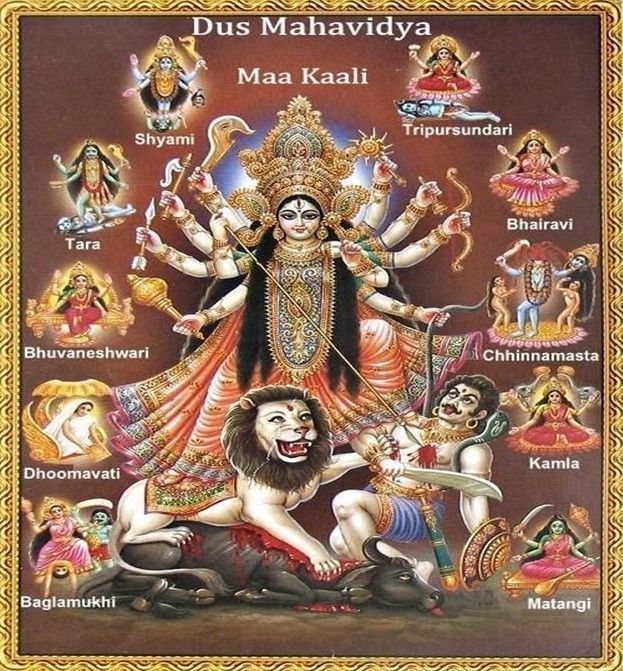
The forms of Goddess Kali set the tone for the Ten Mahavidyas, a complete group of divine manifestations in Hinduism. Each Mahavidya reflects the essence of Kali, who is revered as the embodiment of transcendental consciousness. Her black complexion symbolizes her all-embracing nature, beyond time and space. In Tantrism, Kali is Considered the Ultimate Reality, representing awakened awareness. She is the fierce and ferocious form of the Mother Goddess, born from the brow of Goddess Durga during her battle with demons. Legends narrate that Kali’s uncontrollable rage once threatened universal destruction, until Lord Shiva lay beneath her feet to stop her rampage. Shocked, Kali protruded her tongue, halting her fury. This iconic image Kali standing on Shiva’s chest with her tongue extended captures her paradoxical nature of destruction and compassion.
Diverse Forms of Goddess Kali
Kali’s manifestations are numerous, each carrying unique symbolism and spiritual significance. Among her most recognized forms are Dakshina Kali, Samshan Kali, Maa Kali, and Maha Kali, along with other variations worshipped across India.
Dakshina Kali
Dakshina Kali is one of the most popular forms, depicted standing on Lord Shiva’s chest with her tongue out, her right foot forward, and a sword in her left hand. She is closely associated with the Jagannath Temple, where she is believed to guard the sacred kitchen of Lord Jagannath. This form emphasizes her protective and nurturing qualities alongside her fierce demeanor.
Samshan Kali
Samshan Kali, the Goddess of the cremation ground, is portrayed with her left foot forward and sword in her right hand. This terrifying form is worshipped by tantrics who practice rituals in cremation grounds, seeking liberation through her energy. Samshan Kali embodies the raw power of death and transformation, reminding devotees of life’s impermanence.
Maa Kali
Unlike her violent aspects, Maa Kali represents the benevolent, maternal side of the Goddess. A legend from the Samudra Manthan describes Lord Shiva consuming poison to save the world, which caused him immense suffering. In this myth, Kali nurtures Shiva like a child, feeding him milk to soothe the poison’s effects. Maa Kali thus symbolizes compassion, care, and divine motherhood.
Maha Kali
Maha Kali is revered as Adi-Shakti, the primordial energy and ultimate reality. She is depicted as the universal Mother, battling against ignorance, bondage, and death, while offering compassion to sincere seekers. Maha Kali represents both the destructive force against evil and the eternal source of creation, embodying the cycle of life and liberation.
Other Manifestations
Beyond these primary forms, Kali appears in numerous other avatars, each with distinct attributes:
- Chamunda: Slayer of demons Chanda and Munda.
- Matangi: Fierce reincarnation of Saraswati, Goddess of Knowledge.
- Chhinnamasta: Symbol of death and creation, depicted headless yet life-giving.
- Bagala: Violent avatar embodying control over enemies.
- Bhairavi: Harbinger of death and destruction.
- Tara: Blue-hued form, clad in tiger skin, embodying wisdom.
- Shodasi: Seductive form symbolizing desire and attraction.
- Kamala: Tantric manifestation of Lakshmi, Goddess of wealth.
- Dhumavati: Antithesis of prosperity, representing poverty and detachment.
- Dakat Kali: Protector of dacoits, worshipped in rural traditions.
- Bhadrakali: Guardian of righteousness and protector of the good.
Conclusion
The forms of Goddess Kali reveal her multifaceted nature terrifying yet nurturing, destructive yet protective. Each manifestation serves as a reminder of the cyclical balance of creation and destruction, compassion and wrath. Worship of Kali in her diverse forms continues to inspire devotees, offering spiritual strength, liberation, and a deeper understanding of the divine Mother’s boundless energy.