
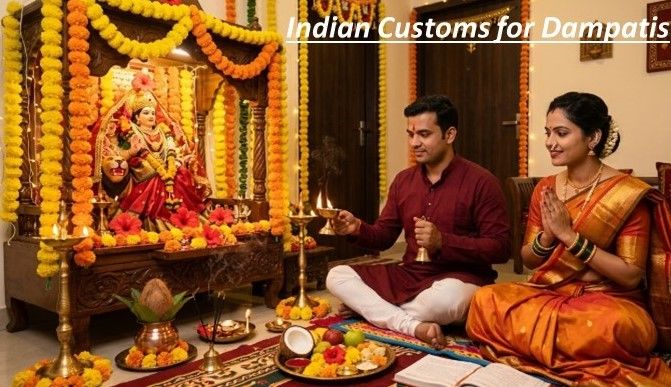
In Hindu tradition, the concept of Dampatisa husband and wife united in marriage—goes far beyond social convention. It represents a sacred and spiritual bond, a lifelong union that is considered indissoluble except by death. Unlike societies where marriage is viewed as a contract, Hindu marriage is regarded as a sacrament, elevating the couple into inseparable partners in both worldly responsibilities and religious observances.
The Sacred Partnership
According to The Dharma Sastras, no ritual performed by a man is complete without the cooperation of his wife. This principle underscores the belief that the wife is not merely a companion but an equal participant in spiritual duties. Whether it is a pilgrimage, the Sraddha ceremony for ancestors, or acts of charity, the wife’s presence is indispensable.
For instance, when a husband donates an item, his wife pours water over it, symbolizing her equal role in the act of giving. Similarly, in the ritual of giving away a daughter in marriage, both parents must jointly perform the formalities; otherwise, the ceremony is considered invalid. This reflects the conviction that religious rites lose their efficacy without the wife’s involvement just as machinery cannot function without all its parts.
Spiritual and Symbolic Dimensions
Ancient sages emphasized the spiritual power of the husband-wife union. They taught that rituals derive their potency from the combined energies of both partners. A vivid analogy compares this union to electricity: just as a spark requires both positive and negative charges, spiritual energy requires the harmonious blending of male and female forces.
In Yoga philosophy, certain centers of the human body are believed to be activated only through the union of both sexes. Thus, a devoted couple becomes a powerful pivot capable of achieving great spiritual and worldly accomplishments. In history, many Dampatis exemplified this ideal, their unity enabling them to perform extraordinary feats. Worshippers who honored such couples were believed to draw blessings and strength from their combined influence.
Decline of the Custom
Over time, the custom of honoring Dampatis has waned. In modern society, even when observed, it is often done superficially, lacking the depth and devotion that once gave it meaning. This decline mirrors broader cultural changes, where ritual participation and spiritual symbolism are sometimes dismissed as outdated.
Yet, the essence of the tradition remains profound. It celebrates equality and partnership in every sphere of life, reminding society that marriage is not merely a social arrangement but a divine union. The recognition of Dampatis affirms that both husband and wife share responsibility in rituals, duties, and acts of devotion.
Conclusion
The customs surrounding Dampatis highlight The Sanctity of Marriage in Hindu thought. Far beyond a legal bond, it is a spiritual partnership where both partners contribute equally to religious and worldly duties. Their union symbolizes balance, harmony, and the blending of forces necessary for spiritual progress. Though modern practices may have diluted the observance, the underlying philosophy continues to inspire respect for the sacred bond of marriage.