
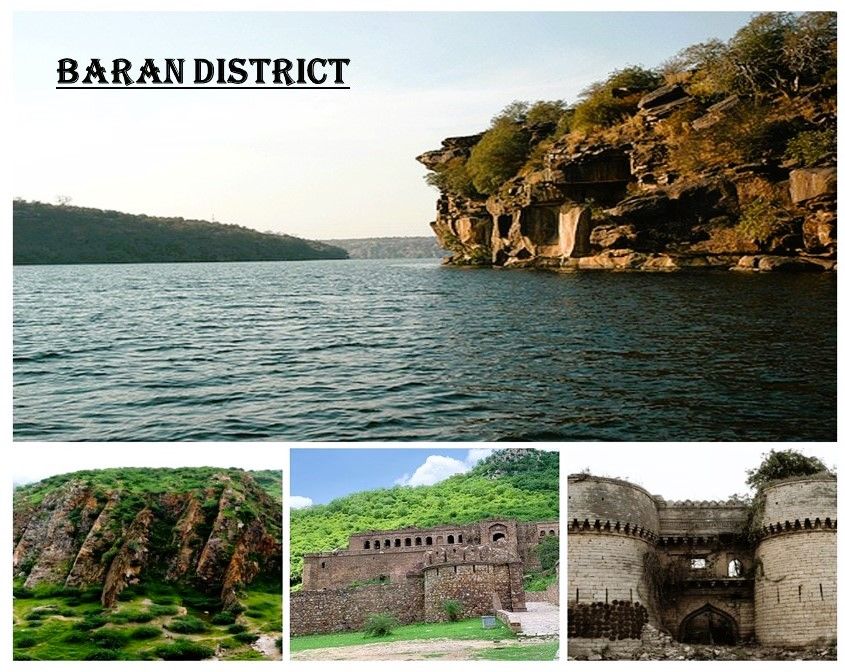
Tucked away in the southeastern reaches of Rajasthan, Baran District is a captivating blend of history, natural splendor, and cultural vibrancy. Often overshadowed by Rajasthan’s more famous destinations, Baran offers a refreshing escape for travelers seeking offbeat experiences. With its ancient forts, sacred temples, lush landscapes, and colorful festivals, Baran is a treasure trove waiting to be explored.
Geography and Natural Charm
Covering an expansive 6,955.40 square kilometers, Baran is predominantly rural, with just 35.88 square kilometers classified as urban. Geographically, it lies between latitudes 24°25′ to 25°25′ North and longitudes 76°12′ to 77°26′ East, with an average elevation of 262 meters. The district shares borders with Kota and Jhalawar in Rajasthan, and Sheopur, Shivpuri, and Guna in neighboring Madhya Pradesh.
Baran terrain gently slopes from the Malwa plateau in the south toward the north, adorned with forested hills in the south, north, and east. The highest elevation point is Mamooni Hill in Shahabad tehsil, rising to 546 meters. The region is nourished by three rivers Chambal, Parbati, and Parban which enrich its soil and sustain its biodiversity. The climate is semi-arid, with monsoon rains from June to September and an average annual rainfall of 895.2 mm.
Historical Legacy
Baran’s historical tapestry is woven with the legacy of the Solanki Rajputs, who ruled the region during the 14th and 15th centuries. The name “Baran” is believed to derive from the twelve villages that formed the Solanki dominion. Before India’s independence, Shahabad and Chhabra tehsils were part of the princely states of Jhalawar and Tonk, respectively.
Over time, Baran came under the influence of various dynasties including the Yaudheyas, Tomars, and Mughals. A notable historical anecdote is Emperor Aurangzeb’s stay at Shahabad Fort, which once housed 18 massive cannons one of them stretching 19 feet in length.
Economy and Industrial Growth
Baran’s economy is primarily agrarian, supported by fertile lands and ample water resources. The District Industries Centre (DIC) plays a crucial role in fostering entrepreneurship and small-scale industries. Key initiatives include:
- Pradhan Mantri Rozgar Yojna: Promotes self-employment among youth.
- Household Industries: Encourages traditional crafts and local products.
- Kargha Ghar Subsidy: Provides financial support to handloom weavers.
- Health and Insurance Schemes: Offers eye-testing and occupational safety coverage.
The NTPC Anta power plant stands as a major industrial establishment, contributing to both energy production and local employment.
Cultural Tapestry
Baran is a vibrant cultural hub, especially known for its festivals that reflect the rich traditions of the Hadoti region. These events are not just celebrations but also expressions of communal harmony and spiritual devotion:
- Dol Mela: A lively fair held after Dol Gyaras, lasting up to 20 days.
- Sitabari Mela: Celebrated near Sitabari, linked to the legends of Sita and her sons Luv-Kush.
- Brahmani Mataji Mela: A religious gathering honoring the local deity.
- Phuldol Folk Festival: A springtime celebration featuring folk music and dance.
- Piplod Christmas Fair: A unique event in the tribal belt.
- Urs: Held at local dargahs, fostering interfaith unity.
These festivals not only preserve Baran’s cultural heritage but also draw visitors from across Rajasthan and beyond.
Must-Visit Attractions
Baran is dotted with historical landmarks and natural retreats that offer a rich travel experience:
- Shergarh Fort: Perched on the banks of the Parvan River, this fort dates back to 790 AD and played a strategic role in regional politics.
- Shahabad Fort: Built in the 16th century, surrounded by dense forests, and once home to powerful artillery.
- Ramgarh-Bhand Devra Temples: Dating to the 10th century, these temples are built in the Khajuraho style and are often called the “Mini Khajuraho of Rajasthan.”
- Sitabari: A serene site associated with the Ramayana, ideal for spiritual retreats.
- Kapildhara: A scenic waterfall and pilgrimage spot.
- Kakoni: Known for its ancient temples and archaeological significance.
- Nahargarh Fort: A lesser-known but historically rich fort.
- Bilasgarh: A ruined city steeped in mythological lore.
- Brahmani Mataji Temple: A revered shrine attracting devotees year-round.
- Tapasviyo ki Bagechi: A tranquil garden linked to ascetic traditions.
- Shahi Jama Masjid: Built during Aurangzeb’s reign, modeled after Delhi’s Jama Masjid, and admired for its intricate architecture.
Connectivity and Access
Baran is well-connected by both road and rail. National Highway 27 traverses the district, linking it to major cities. The district is approximately 339 km from Jaipur, and the nearest railway station lies on the Kota-Bina section of the Western Central Railways. For air travel, the closest airports are in Jaipur, Udaipur, and Jodhpur, offering convenient access to domestic and international travelers.
Why Baran Deserves Your Attention
Baran District is a harmonious blend of heritage, nature, and cultural richness. Its forts whisper tales of bygone eras, its festivals pulse with life, and its landscapes offer serene escapes. For travelers yearning to explore Rajasthan beyond the usual tourist trail, Baran promises an immersive and rewarding experience.
Whether you're a history buff, nature lover, or cultural enthusiast, Baran invites you to discover its many layers. It’s not just a destination it’s A Journey into The Soul of Rajasthan.