
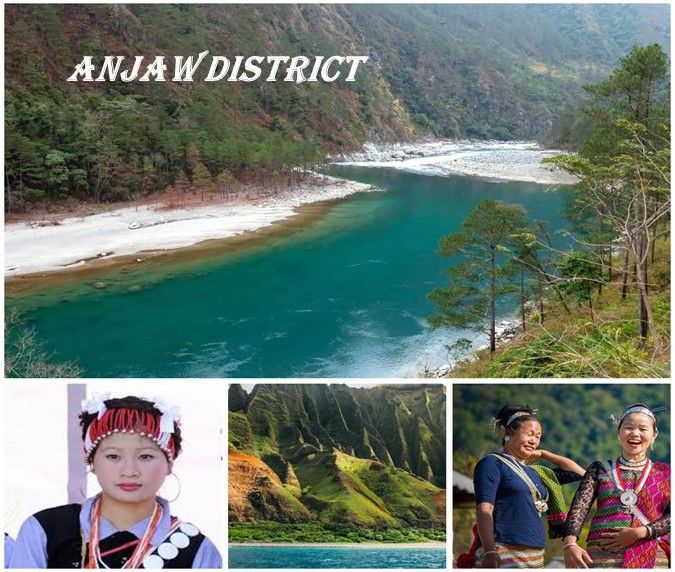
Tucked away in the north easternmost corner of Arunachal Pradesh, Anjaw District is a mesmerizing blend of untouched natural beauty, rich tribal heritage, and strategic geopolitical significance. Officially formed on 16 February 2004 after being carved out from Lohit District under the Arunachal Pradesh Re-organization of Districts Amendment Act, Anjaw holds the distinction of being India’s easternmost district. It shares international borders with China to the north and Myanmar to the east, making it a vital frontier region in India’s defense landscape.
Geography and Administrative Structure
Spanning an area of 6,190 square kilometers, Anjaw is Characterized by rugged terrain, deep valleys, and dense forests. The district headquarters, Hawai, is perched at an altitude of 1,296 meters above sea level on the banks of the Lohit River, a major tributary of the Brahmaputra.
Administratively, Anjaw is divided into eight circles: Hayuliang, Hawai, Manchal, Goiliang, Walong, Kibithoo, Chaglagam, and Metengliang. These circles are connected by winding roads and suspension bridges that traverse the district’s dramatic topography.
Biodiversity and Natural Wonders
Anjaw is a treasure trove of biodiversity. Its ecosystems range from subtropical forests and alpine meadows to roaring rivers and cascading waterfalls. The district is home to several rare and endangered species, including the Mishmi takin, Red goral, Gongshan muntjac, and Leaf muntjac. Bird enthusiasts are drawn to the elusive Sclater’s Monal, a vibrantly coloured pheasant that adds to the region’s ornithological charm.
One of Anjaw’s ecological highlights is the presence of Pinus merkusii, a pine species found nowhere else in northeastern India. The district also shelters a rare flying squirrel species, further emphasizing its ecological importance. Often referred to as “the land of hundreds of waterfalls,” Anjaw’s lush vegetation and dramatic terrain make it a paradise for nature lovers.
Economy and Agriculture
Agriculture forms the backbone of Anjaw’s economy. The district’s farmers cultivate a wide variety of crops, including maize, millet, rice, beans, cardamom, oranges, pears, plums, and apples. While traditional jhum (slash-and-burn) cultivation is still practiced, modern farming techniques are gradually gaining traction. Cardamom farming, in particular, has flourished, positioning Anjaw as a progressive agricultural district.
Historical Context
Anjaw’s administrative lineage dates back to British India when it was part of the Lakhimpur district. In 1914, the British established the North East Frontier Tract, dividing it into sections for better governance. The area now comprising Anjaw fell under the Central and Eastern Section, later renamed the Sadiya Frontier Tract in 1919.
Post-independence, the region underwent several administrative transformations. In 1952, the Mishmi Hills district was formed, with Hayuliang emerging as a key center. The creation of Anjaw as a separate district in 2004 marked a significant milestone in its governance and development.
Demographics and Settlement
According to the 2011 Census, Anjaw has a population of just 21,167, making it the second least populous district in India. With a population density of only 3.42 persons per square kilometer, it epitomizes remoteness and tranquility. The literacy rate stands at 59.4%, and the sex ratio is 805 females per 1,000 males.
The district is predominantly rural, with only 982 residents living in urban areas. It comprises 278 villages and approximately 4,612 households, with an average household size of 4.6 individuals.
Indigenous Tribes and Cultural Heritage
Anjaw is primarily inhabited by two indigenous tribes: The Mishmi and the Meyor (also known as Zakhring). The Mishmi tribe is further divided into sub-groups namely the Idu, Digaru, and Miju Mishmis. These communities have preserved their ancestral customs, dialects, and traditional knowledge systems over generations.
The Mishmi people follow animistic beliefs, worshipping nature and ancestral spirits. Their rituals are deeply embedded in daily life and aim to maintain harmony with the environment. Some Mishmis have also embraced Hinduism and Buddhism, reflecting a blend of spiritual influences.
Traditional governance among the Mishmi is maintained through a council of elders who resolve disputes and uphold customary laws. These informal institutions play a vital role in maintaining social cohesion and cultural continuity.
Art, Craft, and Festivals
The Mishmi are renowned for their craftsmanship, particularly in weaving and bamboo work. Their textiles feature intricate geometric patterns and vibrant colors, used in traditional attire and ceremonial garments. Bamboo is skillfully transformed into household items, musical instruments, and architectural elements.
The Meyor tribe, residing mainly in Kibithoo and Walong, is known for its hospitality and rich oral traditions. They speak a Tibeto-Burman language, alongside Hindi and English. Their cultural life is marked by vibrant festivals such as Losar (Tibetan New Year), Chalo Loku, and Tamladu, which celebrate deities and seasonal cycles.
Tourism and Attractions
Anjaw’s untouched landscapes and cultural richness make it a promising destination for eco-tourism and cultural exploration:
- Hayuliang: Meaning “the place of suspension bridge,” this scenic town offers panoramic views of the Lohit Valley and serves as a gateway to the district.
- Hawai: The district headquarters is known for its serene environment and proximity to the Lohit River, ideal for trekking and birdwatching.
- Chaglagam: A remote village near the Indo-China border, offering insights into the traditional lifestyle of the Mishmi tribe.
- Walong: A site of historical importance due to the 1962 Sino-Indian War, Walong is also famed for its natural beauty and the Namti Plains.
- Dong: The easternmost village in India, Dong is the first place in the country to receive sunlight each day a popular spot for sunrise views and trekking.
- Kibithoo: Located near the China border, this picturesque village is known for its strategic importance and Stunning Landscapes.
Conclusion
Anjaw District remains one of India’s most secluded yet enchanting regions. With its rich biodiversity, tribal heritage, and pristine landscapes, it offers a unique blend of adventure, culture, and serenity. Whether you're a traveler seeking untouched beauty or a researcher exploring indigenous cultures, Anjaw promises an unforgettable experience.