
Introduction
The Ajanta Caves in Maharashtra, India, are celebrated worldwide as masterpieces of Buddhist heritage. Dating from the 2nd century BCE to the 6th century CE, these caves showcase centuries of devotion, artistry, and spiritual pursuit. Among them, Ajanta Cave 2 stands out for its intricate carvings, well-preserved murals, and its function as a monastery-like structure. Though smaller than Cave 1, it remains a striking example of the artistic brilliance and spiritual achievements of the Buddhist community.
Architectural Features
Ajanta Cave 2 shares similarities with Cave 1 but is more compact in design. At both ends of the verandah are small cells with pillared porches. The Architrave above the pillars is divided into three panels, each adorned with symbolic carvings. On the right porch, the central panel depicts a seated naga king with attendants, while the side panels feature pot-bellied yakshas, one of whom represents Kubera in his Buddhist form. On the left porch, the central figure is identified as Hariti, holding a child, symbolizing fertility and maternal protection.
The verandah pillars differ from those of Cave 1. They feature moulded bases, tapering shafts that transition from sixteen sides to thirty-two flutes, decorated with tracery belts, and capitals crowned with double lotuses and an amalaka-like motif. A richly carved doorway, flanked by decorated windows, leads into the pillared hall.
The Hall and Shrine
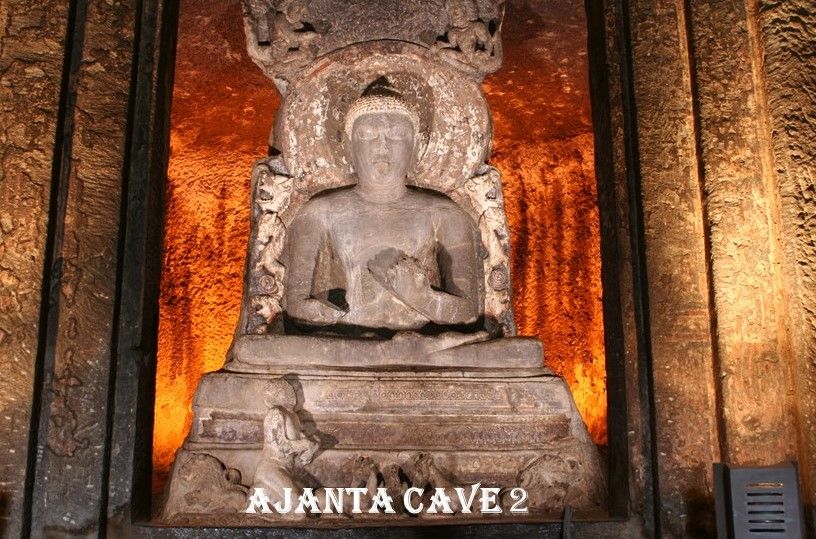
The hall contains twelve elaborately decorated pillars, with the central ones almost over-ornamented. Ten cells line the sides, serving as monastic quarters. The shrine at the back wall features a Buddha in teaching attitude, flanked by chamara-bearers, with Padmapani on the left. The shrine doorway, pillars, and pilasters of the antechamber are richly ornamented, with bracket-figures of nayikas and attendants supporting the architrave.
On the pedestal, a lively group of carvings depicts boys writing before a teacher, boxing, and goading rams to fight, offering a realistic glimpse into youthful mischief and everyday life.
Sculptures and Chapels
The left chapel houses two corpulent yakshasattended by chamara-bearers, notable for their luxuriant curly tresses—a hairstyle frequently seen in Ajanta sculptures. The chapels are adorned with compartmentalized groups of figures, adding depth and richness to the cave’s artistic repertoire.
Paintings and Ceiling Art
Ajanta Cave 2 is remarkable for the survival of its ceiling paintings in the hall, shrine, chapels, and verandah. These paintings are arranged in compartments filled with floral motifs, birds, fruits, flying figures, comic designs, and geometric patterns. The central panels are larger and feature concentric circles with exquisitely rendered flying figures. The shrine ceiling painting is considered one of the finest examples of Ajanta’s artistry.
The walls are painted with countless Buddhas in various attitudes, along with three large Bodhisattvas. Among them, Avalokitesvara is depicted as the saviour of mankind from the Eight Great Perils lion, elephant, fire, snake, robber, water, fetters, and demon.
Narrative Panels and Jatakas
Scenes from the life of Buddha are vividly portrayed. The nativity scene depicts Maya’s dream of a white elephant and the subsequent birth of Buddha. Other panels illustrate the Tushita heaven and the interpretation of Maya’s dream by Brahmanas.
Several Jataka tales are represented, including the Harhsa Jataka (no. 502), where the golden goose Bodhisattva delivers a sermon to the royal couple, and the Vidhurapandita Jataka (no. 545), which narrates Irandati’s marriage, a dice game, and Vidhurapandita’s discourse. The Purna Avadana is also depicted, showing Purna’s conversion and the rescue of his brother.
Conclusion
Ajanta Cave 2 is a treasure trove of Buddhist Art, harmoniously blending architecture, sculpture, and painting. Its richly carved pillars, narrative panels, and exquisite ceiling paintings reflect the spiritual depth and artistic vibrancy of ancient India. Though smaller than Cave 1, Cave 2’s preservation of murals and its unique depictions of everyday life, mythological figures, and Jataka tales make it one of the most captivating monuments within the Ajanta complex.